
Self-concept P1: Self-reflection journaling to understand who you are

“Who am I?” It sounds like a simple question, yet it can open up a whole sky of doubt about your own worth. This is where an identity crisis begins: a stage in which many people get stuck in a loop of searching for meaning in life, sometimes feeling their way by instinct, sometimes borrowing role models from the people around them.
If you rely only on passing emotions or let society carry you along, the search for “who I am” can turn into a vicious circle that wastes the years of your youth. How do you get clear on who you really are and move forward with direction?
The answer lies in Self-Concept.
Self-concept: how you define yourself
Self-Concept is the way you see yourself, including your beliefs, your core values and the ideal image you are working toward. Once you understand your Self-Concept, you can:
- Set a direction for the version of yourself you want to become
- Strengthen the process of transforming yourself
- Shorten your growth time with a “quantum leap”
Self-Concept doesn't create a new version of you. It helps you reach the best version of yourself faster. That version has always existed on some timeline, and your task is to reconnect with it.
There is one truth you have to accept, though: You will never find a perfect answer.
People change all the time, and impermanence is the nature of life. So “Who am I?” has no fixed answer. Answering it is an ongoing process of digging deeper and upgrading yourself.
Why do we need to understand ourselves? (Why)
Decoding yourself lets you see through recurring events, hidden wounds and suppressed emotions. If you often:
- Feel stuck in life or at work
- Make the same mistake again and again
- Have strong emotional reactions without knowing why
then it's a sign that you need to look deeper into yourself.
Our bodies store memories as body memory and tend to react through defense mechanisms. That's why self-reflection helps you identify a problem at its root and heal it completely.
Journaling as a way to understand yourself (What)
One of the most effective tools for getting to know yourself is the Journal: guided writing.
What is a journal?
- This is the journal method: writing in a guided way that works better than ordinary journaling, helping you see the root of a problem and resolve it thoroughly.
- Journal
In English, a journal is a kind of written record. The writing is regular, repeated or continuous over a certain period. Tracking your daily spending, keeping a daily diary, or writing during each holiday or business trip all count as journaling. At its core, the word simply refers to writing. Because people write for different purposes, though, journals are divided into types that make the writing easier and more effective.
This process is personal and private. It lays the groundwork for you to understand your own heart better and break negative loops.
How to reflect on yourself through journaling (How)
To journal effectively, you can use the Holistic Self-Reflection model, which takes you step by step from awareness to transformation:
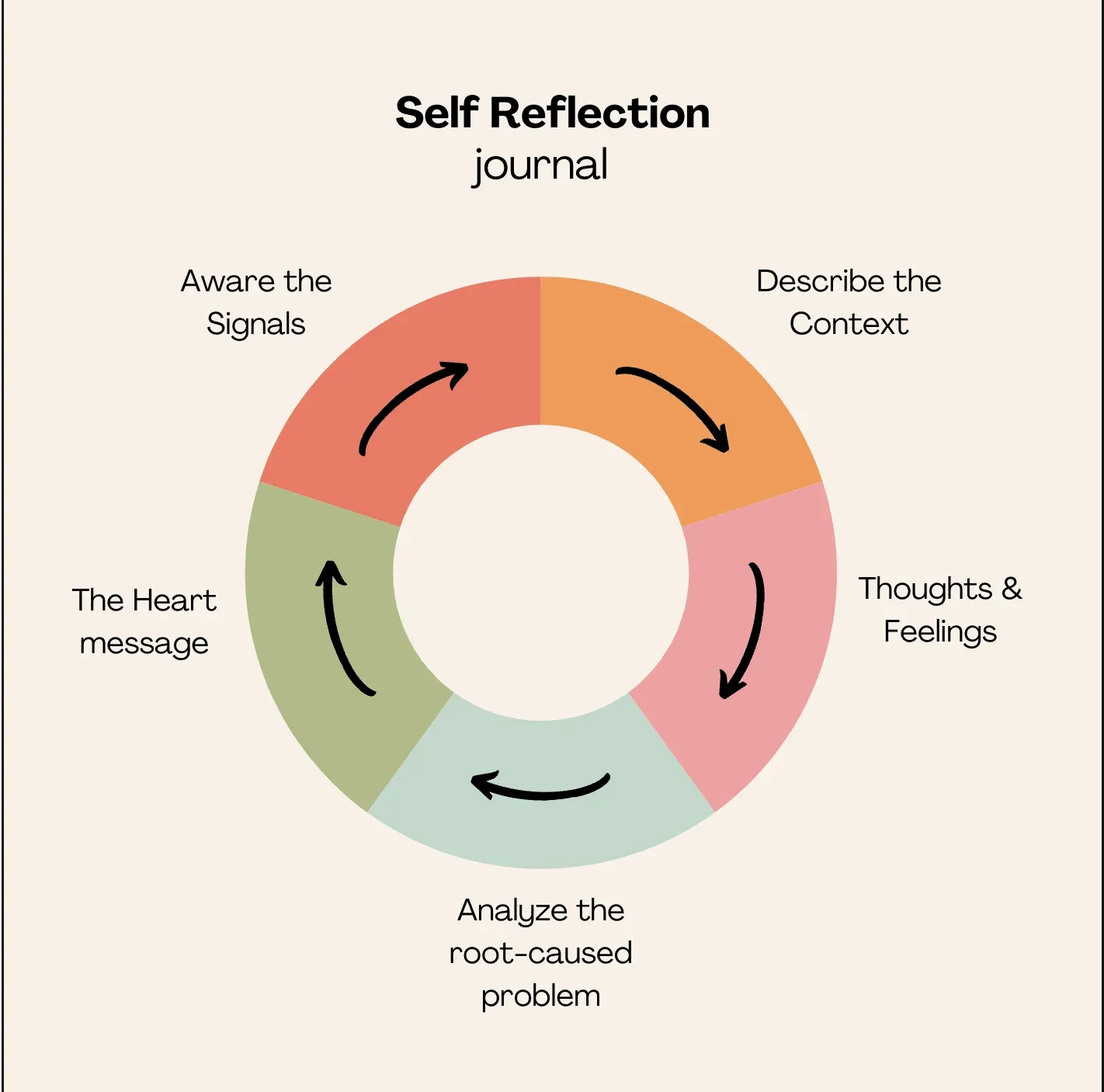
1. Become aware of the signal (Aware the signal)
- What event triggered you?
- What did you feel in your body (cold hands, racing heart, stomach ache, and so on)?
- Was there anything unusual in the days leading up to it?
2. Describe the context
Write freely in the order WHEN - WHERE - WHO - WHAT - HOW - WHY, describing in detail the event that set off your emotions.
3. Unpack your emotions (Thoughts & Feelings)
- How do you feel?
- What are you thinking?
- How is your body reacting?
- How did you behave?
- What from your past does this event remind you of?
4. Analyze the root cause
Use the “5 Whys” method to dig down to the root cause:
- Why did this happen?
- Why does it affect you?
- Why do you have this thought or reaction?
5. Listen to your heart's message (The Heart Message)
- Deep down, what are you hoping for?
- What do you want to change so this doesn't happen again?
- What better outcome do you want?
6. Draw the lesson (And then…)
- What did you learn from this event?
- Identify the signals from inside (emotions, thoughts, bodily reactions) and from outside (the context, other people's behavior).
Self-discovery has no final destination
“Who am I?” has no single fixed answer. It is an ongoing journey in which you keep discovering, learning and transforming to become the best version of yourself.
Practicing journaling and self-reflection helps you decode your identity. It also opens the door to a meaningful life, one you shape yourself instead of being swept along by things that don't belong to you.
Wherever you are on this journey, remember that you always have the right to redefine yourself and write your life story the way you want.